The official NervoVive botanical formula
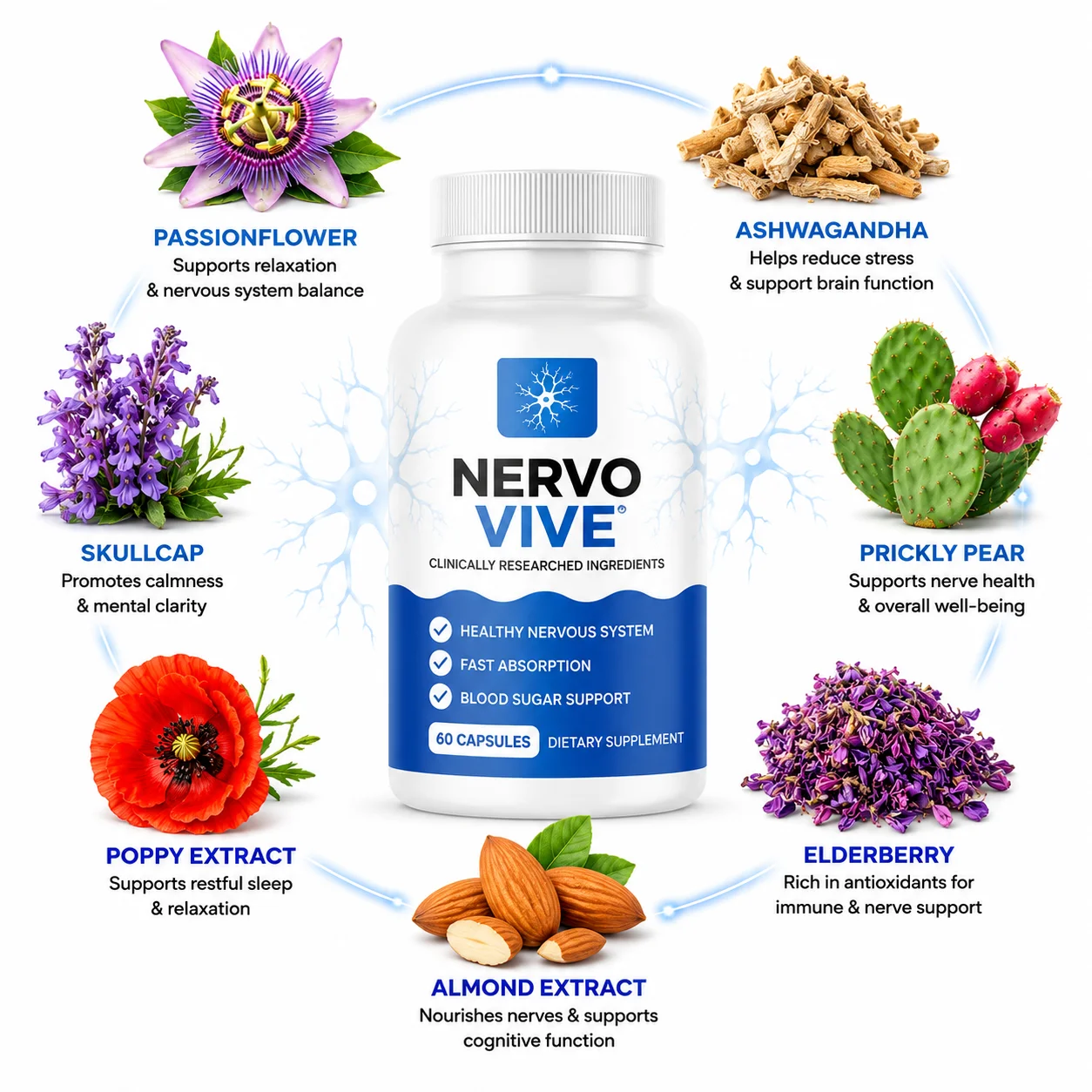
The indexed official presentation lists five core botanicals: Passion Flower, Marshmallow Root, Corydalis, Prickly Pear and California Poppy Seed. Some third-party pages list additional vitamins or alpha-lipoic acid, but because those additions were not consistently confirmed in the official indexed presentation used for this build, we do not treat them as verified current NervoVive ingredients. Check the physical Supplement Facts label before ordering.
| Ingredient | Evidence grade for claimed nerve outcome | Editorial takeaway |
|---|---|---|
| Passion Flower | C — indirect | Human evidence is mainly around anxiety/sleep, not direct nerve repair. |
| Marshmallow Root | D — insufficient | Traditional/soothing use; little direct human nerve evidence. |
| Corydalis | C — preliminary | Pain-related pharmacology exists; much evidence is preclinical or not product-specific. |
| Prickly Pear | C — mixed / indirect | Glucose research varies by product; not established as neuropathy therapy. |
| California Poppy Seed | C — indirect | Some combination-product anxiety evidence; not proof of nerve treatment. |
Promotional ingredient graphic vs. current label
1. Passion Flower
Passionflower is the best documented of the calming botanicals in the formula, but NCCIH says research is limited. Small studies suggest possible effects on anxiety or sleep, while possible side effects include drowsiness, dizziness and confusion. This makes it relevant to “calming” positioning but not evidence that NervoVive repairs damaged peripheral nerves.
2. Marshmallow Root
Marshmallow root is traditionally associated with soothing mucilage. The official reference list includes laboratory work on epithelial cells and animal/other-condition research, but that is not equivalent to a clinical neuropathy trial. We grade the nerve-health evidence as insufficient.
3. Corydalis
Corydalis species contain alkaloids such as tetrahydropalmatine with analgesic and neuroactive research interest. A published mouse model found antihyperalgesic effects, but animal evidence cannot establish clinical efficacy in people with neuropathy. Dose, extract standardization and safety also matter.
4. Prickly Pear
Prickly pear (Opuntia) is often positioned around antioxidants and glucose metabolism. A systematic review found variable effects by cactus component and concluded there was not enough evidence to recommend Opuntia fruit products as an alternative or complementary therapy for type 2 diabetes.
5. California Poppy Seed
California poppy has a history of use in calming formulations. One randomized study evaluated a combination containing Eschscholzia californica with hawthorn and magnesium for mild-to-moderate anxiety. Combination evidence for anxiety should not be repackaged as proof of neuropathy treatment.
What to verify on your bottle
- Exact amount of each botanical per two-capsule serving.
- Whether any vitamins, alpha-lipoic acid or other actives are present on the current label.
- Other ingredients such as capsule material, fillers and flow agents.
- Lot number, manufacturer/distributor information and expiration/best-by information.
- Any allergen or medication-interaction warnings.
Verify the current offer before ordering
Pricing, bundles and availability can change. Use the vendor checkout for the current terms. Purchase buttons on this site route through our centralized /go/nervovive/ page to the configured ClickBank affiliate offer.
Why dose and extract form matter more than ingredient names
Ingredient lists are often treated like a checklist—“contains a good herb, therefore good product.” In reality, clinical relevance depends on the amount delivered per serving, extract ratio, standardization, chemical profile, bioavailability and duration of use. “Corydalis” can refer to different species or extract compositions; “Prickly Pear” can refer to fruit, cladode or other preparations that do not behave identically in research.
That is why we are conservative when a third-party page publishes exact doses that are not consistently visible on the current official indexed presentation. The physical label is the source of truth for what is in the bottle you receive.
Formula-level interaction questions
| Ingredient / role | Possible practical concern | Who should ask a clinician |
|---|---|---|
| Passion Flower — calming | Drowsiness, dizziness, additive sedation | People using sedatives, sleep aids, anesthesia-related medicines |
| California Poppy — calming | Potential additive CNS effects | People using alcohol/sedatives or who need high alertness |
| Prickly Pear — metabolic positioning | Potential glucose-related effects vary by preparation | People on diabetes medicines |
| Corydalis — neuroactive alkaloids | CNS and pharmacologic effects depend on extract | People using multiple medicines or with liver concerns |
| Marshmallow Root — mucilage | May affect absorption timing of other oral substances in theory | People on time-sensitive oral medicines |
Common evidence mistakes in supplement ingredient pages
- Using a cell study to claim a human symptom benefit.
- Using a mouse pain model to claim a clinically proven neuropathy treatment.
- Using a combination trial to credit one ingredient with the entire outcome.
- Using a study on anxiety or sleep to claim nerve regeneration.
- Using a study on blood glucose to claim prevention or reversal of diabetic neuropathy.
- Ignoring whether the studied extract and dose match the product label.
What to do if the label uses a proprietary blend
If a product lists only a total proprietary-blend weight rather than individual ingredient amounts, it becomes harder to compare the formula with research. A blend can be legally labeled while still limiting clinical interpretation. In that situation, ask whether any ingredient can plausibly reach a studied amount within the total blend size.
For a high-trust review site, the correct response is not to guess hidden doses. It is to mark dose-level evidence as uncertain until the current label provides the needed detail.
Which NervoVive ingredients have the most relevant public evidence?
“Most evidence” does not mean “proven for NervoVive.” It only describes the relative depth of the ingredient literature we reviewed. Passionflower has recognizable human evidence for anxiety/sleep outcomes. Prickly pear has systematic-review literature for metabolic outcomes, though results vary. Corydalis has interesting pain pharmacology and preclinical work. California poppy has limited human combination research. Marshmallow root has the least direct human evidence for nerve outcomes among the five.
| Ingredient | Relative evidence depth | Directly proves NervoVive treats neuropathy? |
|---|---|---|
| Passion Flower | Moderate for other outcomes | No |
| Prickly Pear | Moderate/mixed for metabolic outcomes | No |
| Corydalis | Preclinical + pharmacology / pain literature | No |
| California Poppy | Limited combination human data | No |
| Marshmallow Root | Sparse direct nerve evidence | No |
Why the final site should use a real authorized label image
The current build intentionally uses an original illustration rather than copying the manufacturer’s protected packaging. Once you have affiliate approval, the best upgrade is an authorized, high-resolution front bottle image plus a readable Supplement Facts image. The label image is more valuable for SEO and trust than a decorative lifestyle photo because it lets users verify the formula themselves.
Questions we would ask the manufacturer about the formula
- What is the exact amount of each botanical per two-capsule serving?
- Which plant part is used for each ingredient?
- Are extracts standardized to specific active compounds?
- What solvent/extraction method is used for concentrated extracts?
- Are identity, heavy metals, microbes and adulterants tested per lot?
- Is a certificate of analysis available to consumers or affiliates?
- Has the finished combination undergone stability testing through the stated shelf life?
- Has the finished product—not just ingredients—been studied in humans?
These questions are not accusations. They are the difference between a marketing-level ingredient list and a formulation-level assessment.
Our ingredient conclusion
The five-botanical concept is coherent around calming, pain-related and metabolic themes, but the evidence is heterogeneous and mostly indirect for neuropathy. The most useful next upgrade to this page is not another paragraph of benefits; it is a verified current Supplement Facts image with exact doses and extract forms. Once that is available, dose-level comparisons with research become much more meaningful.
Related NervoVive and evidence research
These links connect the product-intent page to the next logical buyer or evidence question without forcing unrelated exact-match anchors into every paragraph.